

Wooden Bench Entryway: 5 Styles by Size and Storage Type

The best wooden bench entryway choice depends on what your entrance has to handle every day. Pick an open-base solid wood bench if you want a design statement and a clear floor. Pick a slatted shoe bench if you own many pairs of shoes. Pick a cubby bench if bags and coats pile up too. Pick a lift-lid chest if you want clutter hidden, and a slim bench if your hallway is narrow.
Most shoppers get stuck because every listing calls itself an entryway bench, yet sizes, materials and storage vary enormously. A bench two inches too deep blocks the door swing. A bench with the wrong storage turns into a pile of shoes with a seat on top.
This article sorts five styles by how they work, who they suit, and the size and storage you can expect. We make solid walnut and oak benches to order in our family workshop in Vietnam, so we write from the bench-maker's side. We also tell you when a bench with built-in storage is the better buy.
1. Sculptural solid wood bench with an open base
A sculptural solid wood bench is one shaped seat on an open base, with no drawers, shelves or lids. It is furniture first and storage second, so it suits entrances where the bench is the focal point and you want a clear floor underneath.
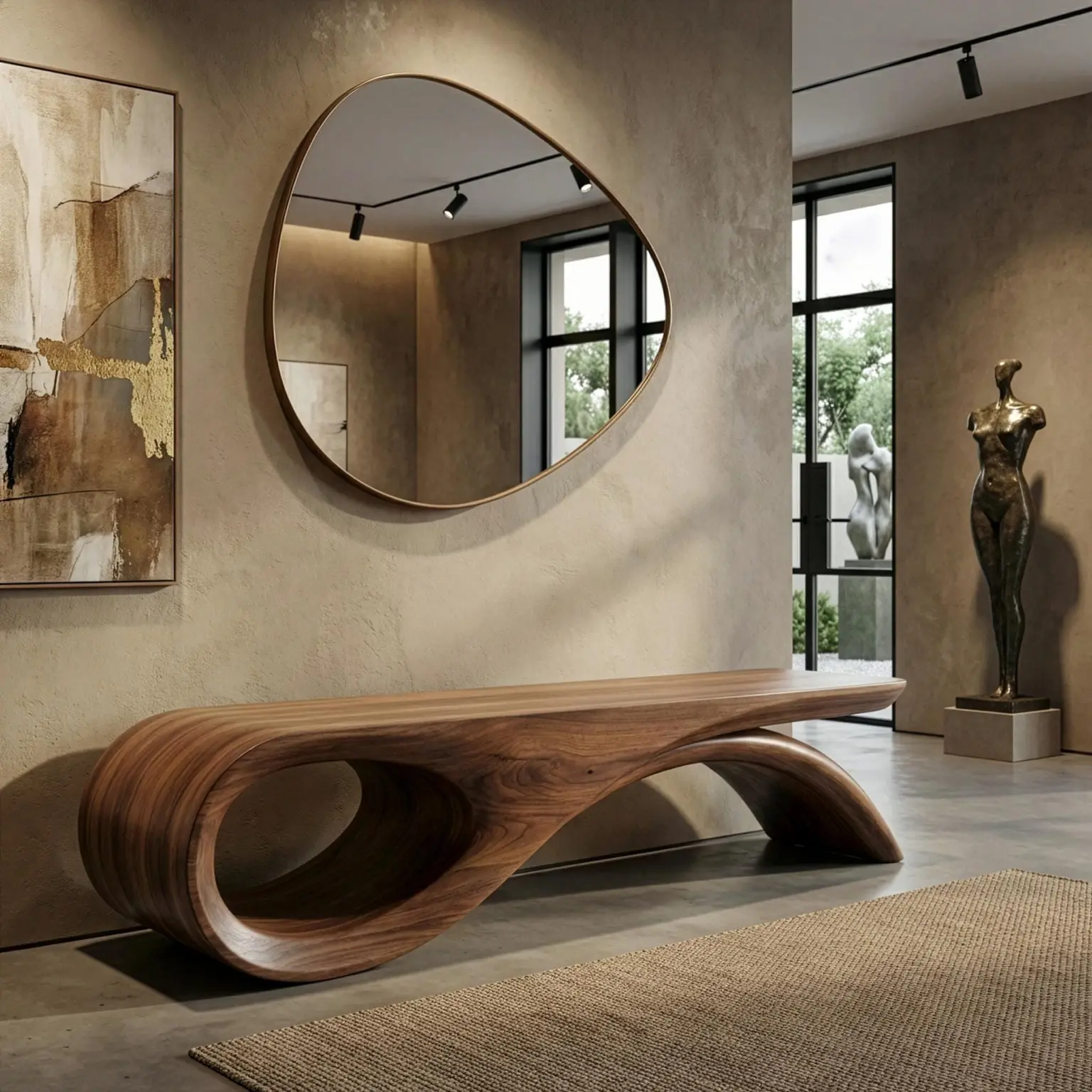
An open base gives up built-in storage and gains floor space, light and a cleaner line.
Size, storage and price
Our benches at VinawoodCrafts come in standard lengths of 47, 55, 63, 71 and 78 inches. Most designs are about 13 to 15 inches deep, and the Black Oak Sculptural Bench is 18 inches deep. Seat heights run around 16 to 18 inches. Benches start around $1,600 and reach about $4,800 depending on size and design, and most are shown at a discount from the regular price.
- Material: solid walnut or oak, with no veneer and no MDF.
- Storage: none built in. Add baskets or wall hooks.
- Lead time: 20 to 25 business days, because each bench is made to order.
- Delivery: free tracked shipping, large pieces packed in wooden crates, and photos of the finished bench sent before it ships.
- Custom options: size, wood type and finish on request.
Who it suits
This style suits you if your entryway is bright and uncluttered and you want one piece that reads as design. Models such as the Solid Walnut Sculptural Bench and the Cantilever Solid Walnut Bench also work in a bedroom or living room later, which helps if you move.
Size it to the wall. On an 84-inch wall, a 63-inch bench leaves about 10 inches on each side, which looks deliberate. Skip this style if you need to store shoes at the door, because an open base only holds a few baskets.
2. Shoe rack bench with slatted shelves
A shoe rack bench puts one or two open shelves under the seat, so shoes stay off the floor and dry in open air. It is the most practical wooden entryway bench for a household that kicks off several pairs a day.
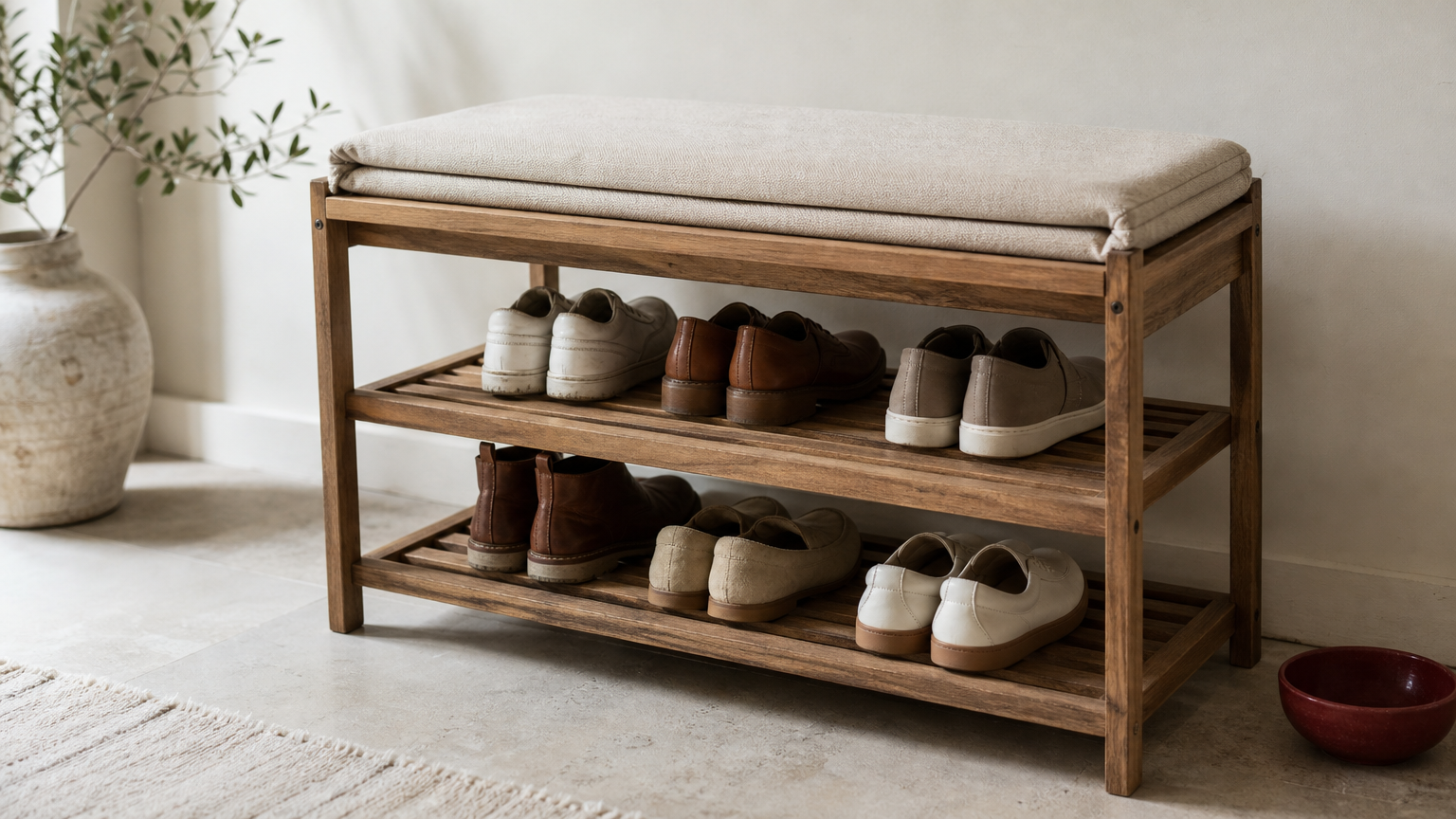
If shoes are the mess, buy the bench that holds the shoes.
Size, storage and price
Most run 36 to 63 inches long, but depth matters more than length. Adult shoes are around 11 to 12 inches long, so a shelf under 12 inches deep pushes toes out the front. Plan on roughly 8 to 10 inches of shelf length per adult pair. A 47-inch two-tier bench then holds about eight to ten pairs.
- Storage: one or two open shelves, sometimes with a cushion on top.
- Seat height: often 18 to 20 inches, because the shelves add height.
- Price: it depends on materials. Many budget versions mix solid wood with MDF, so read the material list.
Who it suits
This style fits families and anyone who sits down to put on shoes every day. Slatted shelves let wet soles dry, which a closed box cannot do.
Open shelves show everything, so a mismatched pile reads as clutter. Tall boots also will not fit under a low shelf. Measure the shaft of your tallest pair before you order.
3. Cubby bench with hooks or a back
A cubby bench, often sold as a hall tree, combines a seat, cubbies or lockers, and hooks or a backrest in one unit. It holds the most gear of any wooden entryway bench, which makes it the closest thing to a mudroom in a hallway.
Cubbies give every person in the house a place to put things, and that is what keeps an entrance tidy.
Size, storage and price
Expect widths of about 36 to 60 inches and depths of roughly 14 to 18 inches. Tall units rise to 60 inches or more once hooks are included. Look for one cubby or hook per household member before you count anything else.
- Storage: cubbies, lockers or baskets, plus hooks above.
- Footprint: the deepest style here, so check the door swing.
- Build: solid hardwood costs more, and it carries the weight of a full set of coats far better than thin panels.
Who it suits
Choose a cubby bench if kids, backpacks and daily coats land at the door. A dedicated spot per person is the main reason it works.
It needs a clear wall and about 36 inches of walking space in front. In a tight hallway it will feel heavy, and you should look at a slimmer style instead.
4. Lift-lid storage chest bench
A storage chest bench has a hinged seat over a closed box, so everything inside is hidden behind the lid. It is a good fit for gloves, scarves, leashes and seasonal items, and a poor fit for wet shoes.
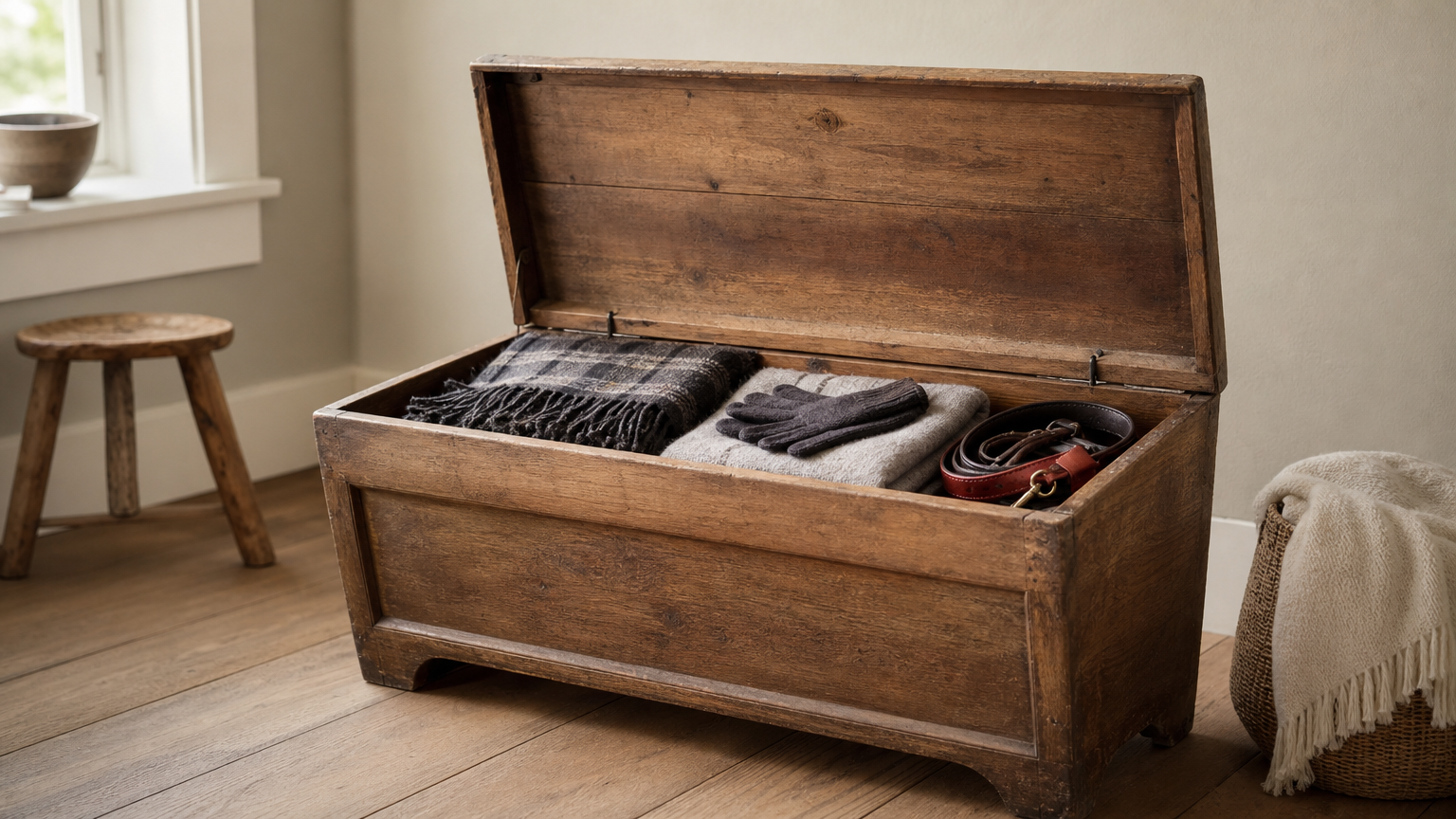
A closed chest gives you the calmest look, but only if what goes inside is dry.
Size, storage and price
Typical lengths run from 36 to 48 inches, with seat heights around 17 to 19 inches. Depth is often 14 to 18 inches. The box is deep, so a chest holds more volume than a shelf bench of the same length. Choose a soft-close or safety hinge if children will use it.
- Storage: one large cavity, usually one lid or two.
- Weight: heavy when loaded, so place it once and leave it.
- Price: solid wood chests cost more than panel versions, and the hinge quality shows over time.
Who it suits
This style suits small households that want a quiet, simple entrance. The seat doubles as a drop zone for everything that is not shoes.
Do not store damp footwear in a closed box, because it invites odor and mildew. You also have to lift the lid to reach anything, which gets annoying with daily-use items.
5. Slim wooden bench for a narrow entryway
A slim bench is about 10 to 14 inches deep and made for hallways and small entries. It gives you a place to sit without cutting into the walkway, and wall hooks or a floor basket do the storage work.
In a narrow hall, every inch of depth you save is an inch of walkway you keep.
Size, storage and price
Depths of 12 to 14 inches suit most hallways, because anything under about 12 inches feels like a perch rather than a seat. Lengths of 30 to 48 inches are common. Measure before you order: the wall width, the door swing, and the walkway left in front, which should stay near 36 inches.
- Storage: none or minimal. Use wall hooks and one basket underneath.
- Seat height: about 16 to 18 inches suits most adults.
- Price: simple designs cost the least, and solid wood still lasts longer than panel builds.
Who it suits
Apartments, renters and narrow hallways are the natural home for this bench. You can take it with you when you move, and it fits many layouts.
If you need real storage in a hall this narrow, go vertical with wall shelves rather than a deeper bench. A slim bench cannot give you both.
Choosing the right bench for your entrance
Pick by what your entrance has to do. An open-base bench gives you design and floor space, a shoe rack bench handles footwear, a cubby bench handles the whole family, a chest hides the odds and ends, and a slim bench saves a tight hall. Measure your wall, door swing and walkway first, then match the depth to your space.
If you want the open-base look in real solid walnut or oak, in a size and finish made for your entrance, see our handcrafted solid wood benches. You can message us on WhatsApp with your wall width and we will help you choose a length.
About VinawoodCrafts
We're a small family workshop in Bac Ninh, Vietnam, handcrafting solid walnut and oak mirrors and furniture. Every piece is made to order, shaped by hand, and photographed for you before it ships. Rated 5.0 ★ by over 200 customers worldwide.